ARCHIVE
2007
THE
WAVE BREAKS FOR PONTIAC
by
Robinson (Durham Wheels)
Fuel
may have come down to saner levels from the summer, but we all
know that once the consumer heat dies down, Big Oil will find
a way to jack prices back up. Canadians have always been predisposed
to compact and subcompact cars, but now even the Americans are
starting to see the wisdom in watching what's going on at the
pump. The problem was, that until recently, a cheaper car meant
it was cheaply equipped with not much more than the essentials.
The Koreans changed that with the Kia Rio and the Hyundai Accent.
Very affordable, they also can be nicely kitted out with spunky
looks and a sporting demeanor to match. The Japanese with the
Toyota Yaris and Honda Fit have jumped in as well. Recognizing
this trend, GM has come up with a little Korean touch of their
own with the Pontiac Wave and the Chevrolet Aveo.GM now operates
the former Deawoo factory in Korea and is importing several
vehicles like the Chevy Optra and Aero and, as tested here,
the Pontiac Wave.
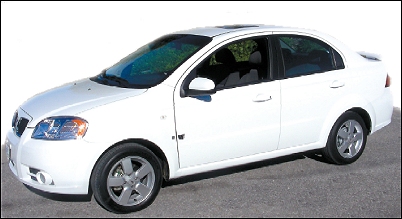
I recently was offered a 2007 Wave Wi during a Pontiac press
event in the Ottawa/Gatineau area. I jumped at it because I
have a weakness for small-bore, small-size sedans and hatchbacks
because, frankly, I think that's all one really needs. While
the Wave starts at $12,950, the trick in this segment is to
offer an up-scale version with a bunch of goodies like alloy
wheels, power sunroof and a full-tilt stereo that appeals to
urban commuters, "young" people and even guys like
me who enjoy wailing a car like this around. The Wi starts as
the SE model at $15,450 that comes with air conditioning, cruise
control, power locks and windows, front reclining seats and
a 60/40 split/fold back seat, "dead man's" pedal and
an AM/FM/CD four-speaker stereo with MP3 player jack. To make
your SE into a Wi Special Edition, $1,095 adds 15-inch alloy
wheels with P185/55 blackwall tires, a rear spoiler, special
badging, premium six-speaker audio system with steering wheel
mounted audio controls and an Apple iPod. For this front-driver
there is a standard five-speed manual transmission with an optional
($950) four-speed automatic. There is a $950 optional tilt and
slide power sunroof. My tester came with the automatic and roof
at the as-tested price (before shipping charge) of $18,580.
Power for the Wave is a 1.6-litre, 16- valve four-cylinder producing
103 hp and 107 lb/ft of torque with what Pontiac calls its Variable
Induction System. In a nutshell, it allows the engine to maximize
the charge across the rev range combined with an electronic
gas pedal that helps improve fuel consumption while reducing
emissions.
Fuel economy rating is 9.1L/100 km (31 mpg city) and 6.3L/100
km (45 mpg) highway. The Wave is equipped to meet Canadian safety
standards with standard second-generation front airbags and
optional side-impact airbags for increased torso and head protection.
Four-channel ABS is available, and in my opinion, well worth
the extra cost. Other standard safety features are what you
would expect including front seat belts with front-load limiters,
lower anchors for children's seats and height adjustable shoulder
belt anchors. In terms of cargo space the trunk behind the 60/40
split rear seats offers 350 litres (12.4 cu ft) of luggage capacity.
With the back seats folded flat, it is quite easy to stow ski
bags with all your boots and poles. In addition to standard
front headrests that tilt, the doors and seatbacks have pockets
as well as hooks on the headrest posts to hold grocery bags
or even backpacks. The doors, for such a small car, are big
and open wide revealing a cabin where the seats are wide and
the cloth is, if memory serves me, of a better quality than
the Wave I drove last year. The dashboard is plain but the instruments
are legible at a glance. I tried the back seat on for size and
there's lots of room for two adults, but three would be pushing
it. You have to fiddle with the driver's seat to find the best
position but the outside mirrors can be nicely sighted. Spin
the key and the 1.6-litre springs to life and you'll be amazed
as how easy it is to rev. I drove the automatic for this test,
but I'd be buying the manual. The Wave is right on the design
crest that sees vehicles becoming ever narrower and taller.
Pontiac did it's best to get the wheels out to all four corners
but the track only allows so much. To compensate, Pontiac fixed
the steering box to the cross member of the front suspension
for stability. The speed sensitive power steering allows for
quick turns at slow speeds, perfect for city driving. The "feel"
through the steering wheel tightens progressively as the speed
increases. Shorter wheelbases always mean quick reaction in
cornering and this is improved by a front stabilizer bar. With
the wider tires and the quick steering, the Wave Wi can be a
lot of fun especially in an interurban setting. On some lovely
roads in the Gatineau area of Quebec, the Wave Wi hummed right
along. There's a lot of sound deadening in the cabin because
I know this engine can be loud particularly when it comes to
induction noise. Another reason for the Wave Wi being so audibly
behaved on the highway is the attention paid to aerodynamics
like the way the headlights are fared back into the fender line
and hood. The body shape is the result of considerable wind
tunnel testing to make it more slippery through the air to lessen
drag and thus use less fuel. Little things like moulding the
radio antenna into the rear glass instead of poking up into
the wind results in a pretty good coefficient of drag of 0.326
or similar to a Porsche.
SOLSTICE
DOUBLES UP ON POWER
by
Robinson (Durham Wheels)
Shown
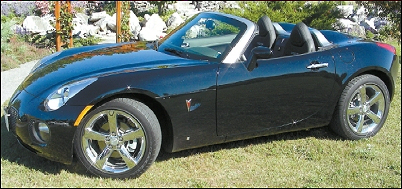
as a concept car at the Detroit Auto Show in 2002, the Pontiac
Solstice was the star of the show. It generated a huge amount
of interest right at the time when General Motors was starting
to fade under the attack of offshore automakers.
By superhuman effort, GM bucked the naysayers, bringing this
car to market in just two and a half years. They did it despite
noteven having a chassis and not being afraid to bring out a
simple roadster at a time when other makers had rejected the
idea as not being viable. Available last year as a 177 hp roadster
with delicious looks, Solstice has now got the attitude to match
for 2007 with the 260 hp Solstice GXP.
From the blunt, twin-nostril grille, the form is almost liquid
as it flows over the cowl past the door then arching up and
over the rear haunches before coming together to the bobbed
rear valance. There are no bumpers, spoilers and rub strips
to spoil the shape. The Solstice looks bigger than the Mazda
Miata, but it's almost identical in every dimension. Credit
the standard 18-inch wheels for creating this optical illusion.
You have to hand it to Pontiac for retaining the look of the
Solstice concept car right down to the arched headrest cowling.
This is one pretty shape and GM has chosen to do it justice.
The interior is minimalist but comprehensive. The instrument
panel sweeps across and then sharply down in the centre like
an inverted "L". Gauges and controls are simple to
understand and use. However, in full sunlight, the electronic
readout in the centre stack for the audio system gets blotted
out. The seats are snug but very supportive with an adequate
amount of travel. Those over six-feet, four-inches will have
to make some compromises especially with the top up. The top
itself is manual and is simple enough to work. You use a button
inside the glovebox or on the remote to pop the rear panel that
opens clamshell-like. The top is on a scissor frame and swings
up into place and can be attached with one clamp to the windshield.
Lastly pop two pins on the buttresses of the top and you're
in business. Previously there was just the one engine for this
rear-drive roadster, the Ecotec 2.4- litre, twincam inline four-cylinder
found in the Pontiac Pursuit economy car. Producing 177 hp and
166 lb/ft of torque, it is a punchy unit with very usable torque.
The big difference for 2007 between the standard Solstice and
the GXP is a turbocharged version of the 2.0-litre Ecotec four-cylinder
with almost double the power of the standard car at 260 hp and
260 lb/ft of torque.
It
is GM's highest specific output engine ever at 130 hp (97 kW)
per litre or 2.1 hp per cubic inch of displacement. The result
is acceleration from 0-100km/h in approximately 5.7 seconds.
Standard transmission is a five-speed manual or an optional
five-speed automatic. With big, 18-inch tires, the grip in the
standard Solstice was already beyond good, but with the 260
hp turbo and special Goodyear F1 tires, you can really dig in.
Where this combination proves its worth, is not off the line
although it really scoots, but in high-speed, sweeping corners.
You can take bends going uphill to the left or right without
lifting. The traction of the tires and the limited slip that
was fitted to my tester allow all the power to go to the road
and not scrub off as normal limits of adhesion are reached.
In GM testing, the nearly identical Saturn Sky Red Line hit
0.90g on the skid pad which is right up there with Porsche and
Corvette Z06. Of course much of this increase in the GXP Solstice
handling over the base model is due to the performance equipment
like Stabilitrak and the Bilstein suspension. But most of all,
the marriage of the turbo and the handling inspire confidence,
an intangible that makes good cars into great cars. I drove
both the GXP with the automatic and the Saturn Sky Red Line
and I preferred the manual. Both cars are identical in terms
of power, chassis and suspension but I found the manual allowed
a lot more of the power band to be used if only because I always
find high power-to-weight vehicles are more flexible to use
with a stick shift. My advice is to get the manual. If you don't
know how to use one, learn, because this car begs to be enjoyed
for spirited motoring.
PONTIAC
OFFERS FUN WITH THE TOP DOWN
by Robinson (Durham Wheels)
The
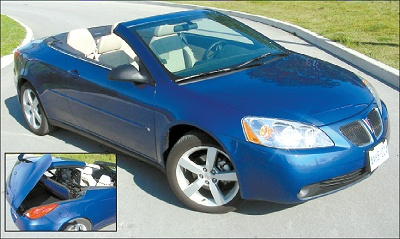
slick lines of the 2006 Pontiac G6 GTP Convertible stem from
the G6 sedan and coupe.
Inset, the hardtop/convertible roof of theG6 is one of the first
offered on an affordable car.
One
of the symbols of the North American good life used to be the
family convertible. The home in the suburbs, a membership at
the club, and a big V8 Big Three convertible was proof that
you had 'made it' in the latter half of the past century. And
while the family convertible also died due to the so-called
"Oil Crisis" in the 1970s and a realization that huge
land yachts were, like smoking, a bad thing, good style always
come back. When Pontiac debuted the svelte G6 midsize coupe
and sedan, I was a bit surprised to hear a hardtop convertible
was in the works. I think of hardtop convertibles as being in
the high luxury class, but here was Pontiac bringing it into
the reach of the average family.
The G6 already comes with what Pontiac calls the Panoramic Roof,
which is four, huge panels of glass that roll open to give a
view of the outside as big as a cargo door on a jetliner. But,
you know, there's something about a convertible four-seater
that's fun. I mean two couples out for dinner at a lakeside
roadhouse, who wouldn't enjoy that? Ergo, say hello to the 2006
Pontiac G6 Convertible. While the G6 is offered in three trim
levels and three different engines, the G6 Convertible is available
as the GT or top-level GTP, as tested here. The GT comes with
a 3.5-litre V6 making 201 hp and 223 lb/ft of torque, while
the GTP gets GM's latest V6, a 3.9-litre unit with variable
valve timing for 240 hp and 241 lb/ft of torque. Both are equipped
with a four-speed electronic automatic transmission driving
the front wheels. The GTP automatic also has a manual, sequential
shift mode and a six-speed manual is also offered on the GTP
as an option.
Fuel consumption for the GTP as tested here is 13.3L/100 km
(22 mpg) and 8.6L/100 km (33 mpg) highway. Traction control
is standard on the GT and GTP but the latter also benefits from
GM's StabiliTrak. It is a version of pitch and yaw control that
uses sensors to detect when the vehicle is starting to go out
of control and uses braking and engine retardation to put it
back on an even keel. The hardtop convertible is a nifty thing
because, in a climate like ours, it gives you the best of both
worlds. All you have to go is press the up/down button located
between the two courtesy lamps near the rearview mirror and,
30 some seconds later, you can let the sun shine in or keep
the rain out.
A friend of mine who is buying a G6 owns a mint Austin Healey
so the top on the G6 is like a dream come true, and as he points
out, four can share the fun. And that is one of the G6 Convertible's
strong points. Even with the front seats occupied, there is
still enough leg and knee room for those in the back seat. The
GTP, as noted earlier, comes with P225/50R18 tires on chrome-look
alloy wheels with a set of summer only (read high performance)
tires optionally available. That's a lot of tire patch on the
road so I noticed the GTP drops the magnetic/ electric power
steering it uses on the Corvette for a hydraulic, rack and pinion
power steering system. Nevertheless, the steering on the GTP
Convertible as tested was quite light to the touch but also
positive to driver inputs. There was a hint of torque steer
to the left at launch but it had to be provoked by giving the
big 3.9- litre full throttle on a wet surface. The high belt
line (the height of the door sill) that slopes up to the rear,
puts the driver down and snug in the cockpit for a very sporty
feeling. The down side is the high rear deck makes it difficult
to judge where the rear bumper is vis-a-vis the car behind you.
This is the trend in today's cars as the trunks get taller to
hold more "stuff", but it does tend to make people
use and rely on their mirrors more often which is always a very
good thing. Next year, the Convertible will only be offered
in GT trim, so if the poke of the GTP is more your style, I'd
say go out and order one now before they're all gone.
AVALANCHE
IS BIG ON LOOKS BUT NOT ON THE WALLET
Durham Wheels - January 5, 2007 - By Mike Johnston
There
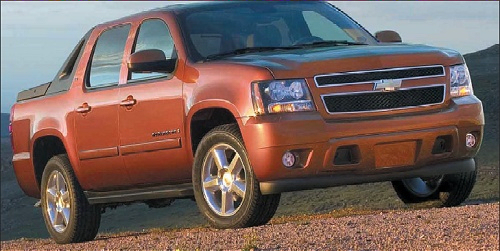
really is only one word to describe the 2007 GM Avalanche -
big. But while using that word every time someone asked me about
Chevrolet's four-door truck, I also threw in stylish, fun to
drive, a head-turner and surprisingly, not the gas guzzler I
thought it was going to be. The Avalanche has been redesigned
for 2007 including a bolder-looking grille, more engine choices,
a stronger frame and a number of new options including power-operated
running boards that automatically extend from the body of the
vehicle when the doors are opened. That would definitely be
one option I would consider. Despite its size, GM's SUV/truck
is easy to drive once you have been behind the wheel for a bit
and while parking may intimidate some, the ultrasonic parking
assist is a big help when pulling in to those tight spots at
any local shopping centre. But it is on the highway where the
Avalanche proves itself as a very safe vehicle. This truck is
very solid and not once did I feel nervous when being passed
by an 18-wheeler. Highway driving was also the biggest surprise
when it came to the pocket book. Thanks to the fuel management
system, half the vehicle's cylinders shut down under light,
or no-load conditions, to save fuel. This was a big selling
point to the environmentalists in the office who looked at the
Avalanche as a gas-guzzling behemoth. Another safety feature
I really liked was the Stabilitrak system, designed to help
drivers retain control of their vehicles during high-speed maneuvers
or on slippery roads. The Avalanche is the first full-size pickup
truck in the industry standard with StabiliTrak. With a large
family of five and weekly stops to hockey arenas and local gyms
for basketball, the Avalanche is a great vehicle to get around
in.
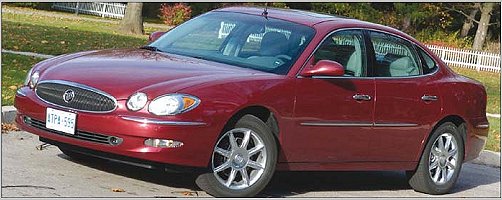
Buick Continues its Allure with
Drivers - by Rob Beintema
Either
I'm getting old or Buicks are getting better. Or maybe both.
The
proof of this is that I seem to be more accepting of traditional
North American car values lately - the smooth-sailing poise,
roomy stretch-out space, quiet comfort and long haul highway
leisure.
These
qualities actually come as a relief after yet another jiggly-piggly
sports car test, the high-horsepower hype of overpriced Euro
sports sedans or the stiff-legged bounce of a big SUV.
And
as to Buicks getting better, well, the proof that the brand
is at least meeting us halfway comes in the form of the 2005
Buick Allure.
The
Allure is Buick's all-new premium midsize sedan, a car based
on a redesigned and responsive platform and chassis, optioned
with a powerful new engine and remodeled inside and out with
modern interpretations of Buick's traditional qualities of quiet
comfort.
The
Allure made an unfortunate misstep coming out of the blocks,
launched in America as the LaCrosse, a name with some derogatory
interpretations in French slang, and hence the badge change
for Quebec and the rest of Canada. Not that I would describe
Allure as a particularly inspiring name to clear that initial
confusion.
But
as a replacement for the Regal and Century sedans, Allure does
clearly signal the future direction for Buick. Despite the addition
of the Rendezvous and Terraza crossover vehicles to the lineup,
the Allure is the first of a new line of Buick cars that should
include a new premium full-size sedan in the immediate future
and a possible convertible further down the road.
The
Allure is offered in three versions - base model CX, mid-range
CXL and the more performance-oriented CXS. The CX and CXL are
powered by one of the old faithful engines in GM's lineup, the
3800 3.8L V-6, now in Series III form. This new version of the
award-winning 3800 generates 200 horsepower. Although the bulk
of the engine is carried over, new features include electronic
throttle control for better engine response and efficiency,
as well as structural upgrades for quieter operation.
The
performance model CXS that I tested for this story harnesses
the more powerful 240 hp 3.6L V-6 VVT (Variable Valve Timing)
engine. This premium, all-aluminum motor has dual overhead camshafts
and four valves per cylinder. The variable intake and exhaust
valve timing helps deliver 90 percent of the engine's peak torque
where it is most useful, between 1600 rpm and 6000 rpm. There
s plenty of power to meet driver's needs and I averaged about
12 litres of regular fuel per 100 km which falls in range with
the Allure s official rating of 12.4L/8L/10.4L/100km (city/hwy/
combined) or about 27 mpg. The standard 3800 V6 runs just a
little leaner on fuel. These powertrain choices use a 4-speed
automatic transmission with overdrive and work in conjunction
with a platform and chassis that is 80 percent changed from
its Regal beginnings. Changes reflect the blended goals of comfort
and control with rebound damper bumpers that are four times
longer for improved cushioning; retuned power steering systems
for improved response and a more precise on-center feel; and
a new aluminum engine cradle and mounting system for quieter
and smoother powertrain performance. The performance-oriented
CXS tightens the ride and handling further with a Grand Touring
suspension with even larger stabilizer bars.
All
models feature 4-wheel disc brakes on bigger wheels -- 16-inch
on CX and CXL, 17-inch on CXS. ABS and various levels of traction
control, including GM's Stabilitrak system, are optional or
standard, depending on model selection. All these mechanical
goodies are encompassed in a new body that is sleek, fairly
stylish and still unmistakably Buick with special attention
to precision panel fitting and chrome accents.
Frankly,
the Buick Allure looks a little goby-eyed to me with the large
headlamps. And the stumpy roof antenna takes some getting used
to. But beauty is in the eye of the beholder, after all, and
the clean and sleek modern exterior has definitely bumped this
model up a notch in style and presence.
The
exterior quality is also reflected inside with a clean, ergonomic
design contrasted with woodgrain and a straight-edge chrome
strip that makes a bold separation across the dash. There's
an elegant 3-dial display, controls on the steering wheel, a
simple square-buttoned center stack and all controls ergonomically
close to hand and right where you expect them to be.
The
Allure comes in either five-passenger or six-passenger seating
configurations. Five-passenger models are equipped with a wide
center armrest with a deep storage area, and a console-mounted
shifter. Six-passenger models open up a front row space with
a column-mounted shifter and a "flip and fold" seatback
cushion that can be converted into a center console/armrest
with a large storage bin. There's more rear legroom than in
previous midsize Buicks because of a 38-mm (1.5-inch) increase
in wheelbase. Front and rear hip room has also increased.
But,
to me, one of the key features of the Allure interior is how
quiet it is. The Allure is the perfect refuge at the end of
a busy work day, thanks to Buick's emphasis on "QuietTuning,"
an all-encompassing approach aimed at reducing unwanted noise
and vibration levels throughout the entire body structure. This
is accomplished through a concerted combination of acoustical
laminates, baffles, melt-on sound deadener and sound-absorbing
pads throughout Allure's engine, passenger and cargo compartments.
The
Allure is a premium sedan, so standard features on all models
include air conditioning, remote keyless entry, power driver's
seat, automatic programmable power door locks with lockout protection,
power windows with express-down driver's window, six-speaker
stereo with CD player, and full interior illumination with delayed
entry/exit lighting and theater-style dimming.
Naturally,
content level goes up with trim levels and there's a list of
bells and whistles that includes side curtain airbags, Ultrasonic
Rear Parking Assist and upgrades to the HVAC and sound systems.
There's
even a Buick-first available factory-installed remote starting
system - convenient in winter and handy for politicians or Mafia
members.
The
Buick CX starts at a reasonable $25,200.
The
CXL lists for $27,865.
And
the well-loaded performance version CXS starts at $33,265. As
tested, my CXS came with a wealth of extras including Platinum
Package ($2,295), power glass sunroof ($1,155), 6CD system with
9 speakers ($1,030) and head curtain airbags ($575). That bumped
the as tested price to $38,320 before additional charges. You
can see from that broad range of models and pricing, that Buick
offers plenty of leeway for customers to blend their needs and
desires into a package that meets their preferences. And with
the starting point of an all-new platform, new engine choices
and new levels of style and sophistication, the Buick Allure
is a good indicator of Buick's trend to a future lineup.
So,
excuse me while this not-so-old driver settles in for a nice
drive, a quiet respite and maybe a little background music.
Hmmm.
No Nirvana. Maybe a bit of Bach.